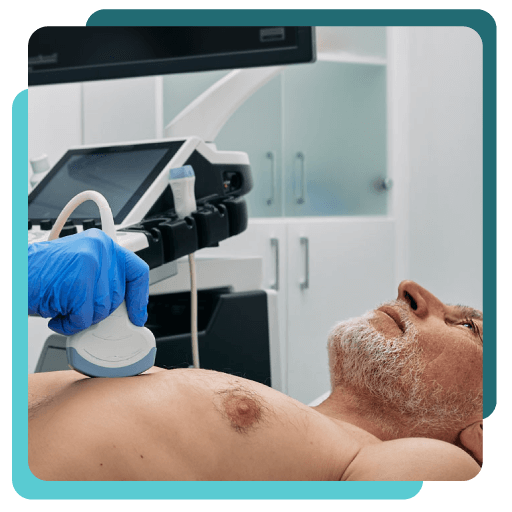
Our echocardiogram technologists scan the chest area looking for any structural abnormalities of the heart.
What is an Echocardiogram?
Echocardiograms are ultrasound exams of the heart. The Echocardiogram Technologist at Primary Care Associates of Appleton will scan the chest area looking at the heart along with any structural abnormalities of the heart. It uses standard two-dimensional, three-dimensional and Doppler ultrasound to create images of the heart. It has become routinely used in the diagnosis, management and follow up of patients with any suspected or known heart diseases. It is one of the most widely used diagnostic tests in cardiology.
An echocardiogram can provide a wealth of helpful information, including the size and shape of the heart (internal chamber size quantification), pumping capacity, and the location and extent of any tissue damage. An echocardiogram can also give physicians other estimates of heart function such as a calculation of the cardiac output, ejection fraction, and diastolic function (how well the heart relaxes).
Benefits of Echocardiograms
Not only can echocardiograms create ultrasound images of heart structures, it can also produce accurate assessment of the blood flowing through the heart, using pulsed or continuous wave Doppler ultrasound. This allows assessment of both normal and abnormal blood flow through the heart.
Color Doppler as well as spectral Doppler is used to visualize any abnormal communications between the left and right side of the heart, any leaking of blood through the valves (valvular regurgitation), and to estimate how well the vales open (or do not open in the case of valvular stenosis).
Echocardiogram Information
The test does not require any preparation for the patient. An echocardiogram is approximately an hour long exam. The patient will need to lay on their left side during the exam, along with their back and occasionally on their right side.
The test is painless but can cause some occasional discomfort, as the technician will need to apply pressure when scanning to acquire adequate heart images.